
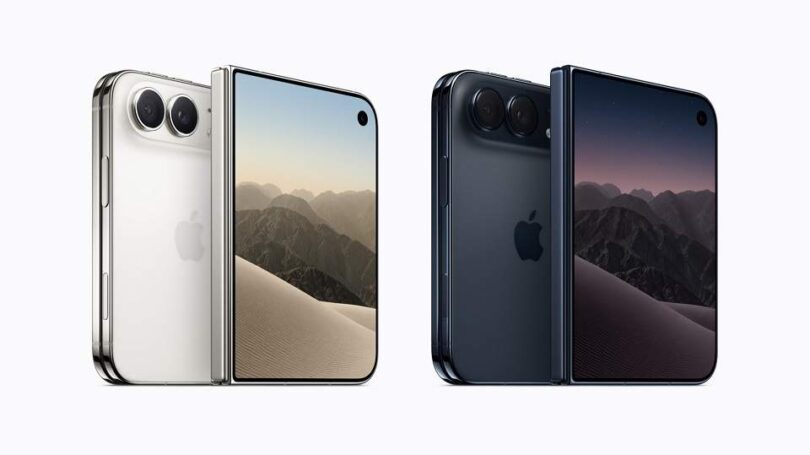

Apple has finally entered the foldable phone market with the iPhone Duo. Starting at $1,999, the Duo is not simply a larger iPhone. It is a completely different form factor. This iPhone Duo review cover design, displays, cameras, performance, battery life, and iOS 27.1.
Closed, it works as a conventional smartphone with a 5.4-inch outer display. Open it, and the device becomes a 7.6-inch workspace. That larger screen is the main reason to buy it.
The iPhone Duo combines Apple’s A20 Pro chip, dual 48MP cameras, ProMotion displays, iOS 27.1, a dual-battery system, and Apple’s ecosystem in a foldable body. Apple also supports Apple Pencil (USB-C), with support scheduled to arrive later in 2026.
But the Duo also asks buyers to accept several compromises.
It weighs 254 grams and measures 11.3mm thick when closed. The starting price is considerably higher than Apple’s conventional flagship phones. Its camera system also lacks the dedicated telephoto hardware found on the iPhone 18 Pro Max.
There is another important point.
This is Apple’s first foldable iPhone. Specifications tell us a lot about the product, but they cannot yet tell us everything about long-term hinge reliability, sustained performance, real-world battery endurance, or years of display durability.
Those questions require extended independent testing.
Editor’s note: This is a pre-release review and buying analysis based on Apple’s published specifications and announced features. Independent testing of long-term durability, sustained performance, battery endurance, and camera quality should be considered separately.
Our Verdict
The iPhone Duo is a specialized flagship, not the iPhone everyone should buy.
Its strongest feature is the 7.6-inch foldable display. That screen can make reading, multitasking, video consumption, document work, and some productivity tasks more comfortable than they are on a conventional phone.
The redesigned iOS experience is also important. Apple has built software features around the foldable design rather than simply stretching the regular iPhone interface across a larger screen.
That makes the Duo particularly interesting for people who want a phone that can handle some tablet-like tasks without carrying a separate tablet.
However, the iPhone 18 Pro Max remains the more sensible choice for most conventional iPhone buyers.
It costs much less, has a conventional design, and offers a more versatile camera system with a dedicated 48MP Fusion Telephoto camera and greater optical-quality zoom capability.
The Galaxy Z Fold8 is another serious competitor. Samsung’s foldable is lighter and thinner, while also offering a 7.6-inch inner display and a larger outer display.
So the question is not simply whether the iPhone Duo is good.
It is.
The better question is whether the foldable experience is worth paying $1,999 for.
For buyers who specifically want a foldable iPhone and will regularly use its larger display, the answer can be yes.
For everyone else, the iPhone 18 Pro Max remains the safer choice.
Twitiq verdict: Buy the iPhone Duo for its foldable experience, not simply because it is Apple’s most expensive iPhone.
What Is the iPhone Duo?
The iPhone Duo is Apple’s first foldable iPhone.
Instead of using one fixed display, it has two screens connected by a precision hinge. When closed, you use the 5.4-inch outer display like a conventional smartphone. When opened, the device reveals a 7.6-inch folding OLED display.
That gives the Duo two distinct ways to use the same phone.
You can keep it closed for calls, messaging, quick browsing, navigation, and other everyday tasks. Open it when you need more screen space for reading, multitasking, watching videos, editing content, or working with supported applications.
Apple describes the inner display as the largest display ever used on an iPhone. It uses a Super Retina XDR OLED panel with a nano-texture finish.
The outer display is also a Super Retina XDR OLED panel. Both displays support ProMotion with adaptive refresh rates up to 120Hz.
How Does the Foldable Design Work?
The Duo folds around a central hinge.
When closed, the two sides sit together. Open it, and the two halves form a larger working surface.
Apple has also designed iOS around different positions and orientations. This means the inner display is not simply a stretched version of the outer screen.
The result is closer to carrying a phone and a small tablet in one device.
It is not a replacement for every tablet task. But it can reduce the number of times you need to switch to a larger device.
What Makes the Duo Different From a Regular iPhone?
The biggest difference is screen area.
A conventional iPhone gives you one display. The Duo gives you a 5.4-inch outer display and a 7.6-inch inner display.
That extra space changes how certain tasks work.
Reading long documents becomes more practical. Supported multitasking layouts can place more information on the screen. Video gets more room. Documents can be easier to review.
The Duo also introduces camera features that take advantage of its two-display design.
For example, Duo Preview allows the person taking a photo to see the camera preview on the outer display. This can also help subjects see how they are positioned in the frame.
These features are possible because of the foldable design.
That is the key point throughout this review.
The Duo is not simply an iPhone with a flexible screen. Apple has redesigned parts of the software, camera experience, and hardware around the ability to open and close the device.
iPhone Duo Price and Storage
Price is one of the biggest factors in the iPhone Duo buying decision.
The iPhone Duo starts at $1,999 in the United States for the 256GB model.
Apple offers four storage options:
| Storage | U.S. Starting Price |
| 256GB | $1,999 |
| 512GB | $2,199 |
| 1TB | $2,599 |
| 2TB | $3,199 |
The top-end 2TB version costs $1,200 more than the base model.
That is a substantial difference, so storage selection deserves some thought before buying.
Is 256GB Enough?
For many users, 256GB should be enough.
It can handle everyday photos, videos, apps, documents, downloads, and offline content. iCloud can also reduce the amount of locally stored data if you already use Apple’s cloud storage.
The larger storage options make more sense for users who record a lot of high-resolution video or keep large amounts of media locally.
This is particularly relevant because the Duo supports advanced video recording, including 4K Dolby Vision at up to 120fps on the Fusion Main camera.
If you plan to use the Duo as a serious video-creation device, storage can disappear quickly.
Which Storage Option Makes Sense?
The 256GB model is the sensible starting point for most buyers.
The 512GB version is worth considering if you regularly shoot a lot of video or prefer keeping large amounts of content locally.
The 1TB and 2TB models are harder to justify for typical smartphone use. They are mainly aimed at users with unusually large storage requirements.
Remember that the Duo already starts at $1,999 before accessories, AppleCare+, or additional cloud storage.
For most buyers, it makes more sense to identify their actual storage needs rather than automatically choosing the largest capacity.
Is the iPhone Duo Too Expensive?
There is no getting around the fact that the Duo is expensive.
At $1,999, buyers are paying for more than processor performance. They are paying for the foldable form factor, two-display experience, specialized hardware, and Apple’s approach to foldable software.
The price makes more sense when the foldable design is central to the buying decision.
If you simply want a fast iPhone with a good camera, paying $1,999 is difficult to justify.
If you specifically want a foldable iPhone and expect to use the 7.6-inch display every day, the calculation changes.
That is the key distinction.
The iPhone Duo’s value is not determined by specifications alone. It depends on how much you will actually use the foldable experience.
iPhone Duo Design and Build
The iPhone Duo has to solve a difficult design problem.
It needs to work as a normal smartphone when closed. It also needs to become a much larger device when opened.
Apple has built the Duo around that transition.
When open, the phone is only 5.2mm thick. Folded shut, it measures 11.3mm.
The Duo weighs 254 grams.
That makes it heavier than the Galaxy Z Fold8, which weighs 201 grams.
The trade-off is the larger inner display.
A Titanium Foldable Design
Apple uses a Grade 5 titanium frame and hinge cover.
The hinge is one of the most important components in any foldable phone. It has to allow the two halves to open and close while maintaining alignment between the displays.
Apple has designed the Duo around a folding structure rather than simply placing a flexible panel inside a conventional phone body.
A foldable phone has more mechanical components than a traditional smartphone. The hinge, flexible display, protective layers, and internal structure all have to work together.
The long-term durability of those components will need to be evaluated through extended real-world use.
How Does the Duo Feel When Closed?
When closed, the Duo has a 5.4-inch outer display.
This is useful for quick tasks.
You can check messages, browse the web, make calls, use navigation, and handle everyday applications without opening the phone.
That means you do not have to unfold the Duo every time you use it.
The closed design also gives the phone a conventional smartphone footprint. However, at 11.3mm thick, it is noticeably thicker than a standard iPhone.
That is one of the unavoidable compromises of the foldable design.
What Happens When You Open It?
Opening the Duo reveals the 7.6-inch inner display.
This is where the design starts to make more sense.
The larger screen provides considerably more space for apps and content. Apple has also developed iOS features around the larger display, including flexible layouts and Split View.
A document can occupy more screen space. Two supported apps can share the display. Video content gets a larger viewing area. Websites and long-form content can be easier to read.
For productivity-focused users, this is likely to be the most important part of the Duo’s design.
What About the Foldable Crease?
The inner display still folds along the central hinge area.
Apple has designed the display to reduce the visibility of the crease. The nano-texture finish is also designed to reduce reflections and glare.
That does not mean the fold is physically absent.
The display still needs to bend along the hinge area.
The more useful question is whether the crease becomes distracting during normal use.
That will depend on lighting, viewing angle, and personal sensitivity. Independent hands-on testing will be needed to determine how noticeable it is in everyday use.
Is the iPhone Duo Water Resistant?
The Duo has an IP68 rating.
Apple specifies protection at a maximum depth of 6 meters for up to 30 minutes under IEC 60529 conditions.
That provides useful protection against dust and water exposure.
However, water resistance is not permanent. It can decrease through normal wear or physical damage.
The IP68 rating should therefore be viewed as protection rather than an invitation to deliberately expose the phone to water.
The Biggest Design Trade-Off
The Duo’s design comes down to one simple trade-off:
You are carrying more phone in exchange for having more screen when you need it.
At 254 grams and 11.3mm thick when closed, the Duo is not designed for buyers who prioritize the lightest possible smartphone.
Its appeal is different.
You carry a heavier phone because you want the option of opening it into a 7.6-inch device.
For someone who regularly reads, works, watches videos, or multitasks on a phone, that trade-off may be worthwhile.
For someone who prefers a lightweight conventional smartphone, it may not be.
iPhone Duo Displays
The displays are the main reason the iPhone Duo exists.
When closed, you get a 5.4-inch Super Retina XDR OLED display.
Open the phone, and you get a much larger 7.6-inch Super Retina XDR OLED display.
Both screens support ProMotion with adaptive refresh rates up to 120Hz, Always-On display technology, HDR, True Tone, P3 wide color, Dynamic Island, and Haptic Touch.
The important difference is not simply screen size.
The inner display changes what you can realistically do with the phone.
The 5.4-Inch Outer Display
The outer display measures 5.4 inches diagonally and has a resolution of 1398 × 2034 pixels at 460 pixels per inch.
It is designed for everyday smartphone use.
You can check notifications, answer messages, browse websites, make calls, and use apps without unfolding the device.
The outer screen also supports ProMotion up to 120Hz.
Scrolling and supported animations should therefore feel smoother than on a conventional 60Hz display.
The 7.6-Inch Inner Display
Open the Duo and the experience changes.
The inner screen measures 7.6 inches diagonally and has a resolution of 1878 × 2670 pixels at 430 pixels per inch. It uses a Super Retina XDR OLED panel with a nano-texture finish.
The larger display provides substantially more working space than the outer screen.
This is particularly useful for reading long articles, reviewing documents, using supported multitasking layouts, watching videos, and working with applications designed for the larger layout.
Apple says the inner display is 50 percent larger than the iPhone 18 Pro Max display.
That is a meaningful increase in usable screen area.
Does the Duo Have a Crease?
Yes.
The inner display still folds along the central hinge area.
Apple has designed the display to reduce the visibility of the crease and uses a nano-texture finish to reduce reflections.
Foldable displays can be more difficult to view when strong light reflects directly from the screen. Reducing reflections can therefore make the larger display easier to use in bright environments.
Still, real-world crease visibility will depend on lighting, viewing angle, and individual perception.
Are Both Displays 120Hz?
Yes.
The Duo does not limit ProMotion to the larger screen.
Both displays support adaptive refresh rates up to 120Hz. The refresh rate can change depending on what is happening on the screen.
This can provide smoother scrolling while helping manage power consumption when high refresh rates are unnecessary.
Which Display Is Better?
The answer depends on what you are doing.
The outer display is better for quick interactions.
The inner display is better when you need workspace.
That distinction is what makes the Duo more interesting than simply giving users one large screen.
You can choose the smaller screen when speed and simplicity matter. You can open the phone when the task benefits from additional space.
That flexibility is the real display advantage.
iOS 27.1 on the iPhone Duo
Hardware alone cannot make a foldable phone successful.
The software needs to understand the changing screen configuration.
This is one area where Apple’s approach to the Duo is particularly important.
iOS 27.1 is designed around the foldable form factor, with layouts and controls that adapt to the larger display and different device positions.
Apple has introduced flexible views and Split View for supported tasks.
When the phone is open, the software can make better use of the additional display area rather than simply enlarging the conventional iPhone interface.
Why Foldable Software Matters
A larger screen does not automatically make a phone more productive.
If an application simply stretches across the larger display, the additional space may not provide much practical benefit.
The value comes when the software uses that space intelligently.
Split View is one example.
Instead of repeatedly switching between applications, supported workflows can place information and tools in a larger shared workspace.
That can be useful for research, document work, communication, and other multitasking scenarios.
Will Every App Work Perfectly?
Not necessarily.
Foldable software is still an evolving area.
Apple has provided developers with tools to adapt applications to the Duo’s different screen configurations. The quality of the experience will therefore depend partly on how quickly developers optimize their applications.
This is an important distinction.
Apple can provide the hardware and operating system framework. Developers still need to make their individual applications take advantage of it.
iOS Is a Major Part of the Duo Experience
The Duo is therefore more than an iPhone with a folding screen.
The success of the product will depend on how well hardware and software work together.
If applications adapt well, the 7.6-inch screen can become a genuine workspace.
If applications do not take advantage of the additional space, some of the display’s potential will be wasted.
For early buyers, this is one area worth watching closely.
iPhone Duo and the Apple Ecosystem
The Apple ecosystem remains an important part of the Duo’s appeal.
If you already use a Mac, iPad, Apple Watch, AirPods, or other Apple devices, the Duo fits into an environment you may already know well.
Features such as iCloud, AirDrop, Handoff, and other Continuity functions can make switching between Apple devices easier.
This matters because the Duo is not simply competing against other foldable phones.
It is also competing for the place of the primary device in an existing workflow.
Is the Duo Better for Existing Apple Users?
Potentially.
An existing Apple user already has access to many services and workflows that can work with the Duo.
For example, you can move files through AirDrop, continue supported activities between devices, access iCloud content, and use the Duo alongside a Mac or iPad.
The foldable design then becomes an additional capability inside an ecosystem you already understand.
However, ecosystem integration should not be treated as a unique Duo feature.
Much of Apple’s ecosystem works with other recent iPhones.
The Duo needs to provide value through its foldable design as well.
Is the Duo Useful With a Mac?
Yes, particularly for people who use a Mac as their primary computer.
The Duo can act as a larger mobile companion when you are away from the Mac.
You can move between devices using Apple’s Continuity features, access files and services through iCloud, and use AirDrop to transfer content.
The larger inner display can also make the Duo more useful when reviewing documents or information away from your desk.
But it does not replace a Mac.
A Mac remains much better suited to extended desktop work, professional applications, and complex multitasking.
The Duo’s advantage is portability.
You get more workspace without carrying another large device.
iPhone Duo Camera Review
The iPhone Duo has a dual 48MP rear-camera system.
It consists of:
- 48MP Fusion Main
- 48MP Fusion Ultra Wide
The Fusion Main camera uses a 26mm equivalent focal length and an ƒ/1.6 aperture. It also has sensor-shift optical image stabilization.
The Ultra Wide camera provides a 13mm equivalent focal length, an ƒ/2.2 aperture, and a 120-degree field of view.
The main camera also provides a 12MP optical-quality 2x Telephoto option through the main sensor.
Apple lists a 4x optical-quality zoom range and digital zoom up to 10x.
Is There a Dedicated Telephoto Camera?
No.
This is an important difference between the Duo and the iPhone 18 Pro Max.
The Duo’s 2x optical-quality telephoto option comes from the main camera system.
The 18 Pro Max has a dedicated 48MP Fusion Telephoto camera.
That gives the Pro Max greater flexibility for longer-range photography.
If camera versatility is your top priority, the 18 Pro Max remains the stronger choice.
What Makes the Duo Camera Different?
The foldable design creates several camera features that are not available in the same way on conventional iPhones.
Duo Preview is one example.
It allows the subject to see the camera preview on the outer display while the phone is being used in a different position.
Smart Take is another feature. Apple says it uses on-device AI models to help capture better moments automatically.
The folding design can also allow the Duo to stand on its own for hands-free photography and video calls.
These features do not necessarily make the Duo a better camera phone.
They make the camera experience different.
What About Video Recording?
The Duo supports 4K Dolby Vision recording at up to 120fps on the Fusion Main camera.
It also supports Cinematic mode, Action mode, macro video, spatial audio, Audio Mix, and other video features.
For creators, the ability to record high-resolution video at high frame rates is significant.
However, specifications alone do not tell us how the Duo will perform during long recording sessions.
Thermal behavior, stabilization, autofocus, low-light performance, and battery consumption all require hands-on testing.
Is the Duo Camera Good Enough for $1,999?
The camera is capable, but it should not be the main reason to buy the Duo.
The iPhone 18 Pro Max offers a more complete camera system.
The Duo’s main selling point is the foldable display.
If you want the best conventional iPhone camera setup, the 18 Pro Max is the more logical choice.
If you want Apple’s foldable experience and still want a high-end camera system, the Duo makes more sense.
iPhone Duo Performance
The iPhone Duo uses Apple’s A20 Pro chip.
The chip includes a 6-core CPU, a 7-core GPU with Neural Accelerators, a dual 16-core Neural Engine, and hardware-accelerated ray tracing.
On paper, this gives the Duo the hardware expected from a premium flagship.
It should have the processing capability needed for demanding applications, photography, video editing, gaming, multitasking, and Apple’s AI features.
But there is an important distinction between specifications and real-world performance.
Because the Duo is a new foldable design, sustained performance, thermal behavior, and battery impact need independent testing.
Is the iPhone Duo Good for Gaming?
The hardware suggests that it should be capable of running demanding games.
The A20 Pro is a high-end mobile processor, while the 7-core GPU is designed for graphics workloads.
The larger 7.6-inch display could also provide a more immersive gaming experience.
A bigger screen can provide more room for game interfaces and controls.
However, we should avoid calling the Duo a better gaming phone before independent testing.
Long gaming sessions generate sustained heat and place continuous demands on the processor and battery.
How effectively the Duo handles those conditions will need to be tested.
What About Multitasking?
This is where the processor and larger display work together.
Performance alone does not make multitasking useful.
The Duo combines the processing power needed to run demanding applications with a 7.6-inch display that gives those applications more room.
With supported software, Split View and other larger-screen layouts can make it easier to work between tasks.
The processor provides the performance.
The foldable display provides the workspace.
Neither advantage is as useful on its own.
Performance vs. the iPhone 18 Pro Max
Both the Duo and iPhone 18 Pro Max use Apple’s A20 Pro platform.
That means the processor itself is not the main reason to choose one over the other.
The bigger differences come from physical design, display, camera system, battery configuration, and thermal characteristics.
The 18 Pro Max has a conventional body.
The Duo has two displays and a hinge.
As a result, benchmark results alone may not tell the whole story.
A foldable device can have the same processor while behaving differently under sustained workloads because of differences in cooling, battery design, and internal space.
Our Performance Verdict
The iPhone Duo has flagship-class processing hardware.
The A20 Pro provides a powerful CPU, GPU, Neural Engine, and ray-tracing capabilities.
That gives the phone a strong foundation for gaming, photography, video, multitasking, and AI workloads.
But the more interesting performance question is what happens during long, sustained workloads.
Until independent testing is available, we should not claim specific benchmark scores, frame rates, thermal limits, or sustained performance figures.
For now, the sensible conclusion is simple:
The iPhone Duo has flagship-class processing hardware. Its real-world performance will depend on how effectively that hardware works within Apple’s new foldable design.
iPhone Duo Battery Life and Charging
Battery life is particularly important on a foldable phone.
The iPhone Duo has two displays, a powerful A20 Pro chip, and a dual-battery system.
Apple rates the Duo for up to 24 hours of typical use.
That figure is useful for comparison, but it should not be interpreted as a guarantee that every user will get 24 hours between charges.
Actual battery life depends on screen brightness, network conditions, applications, gaming, video recording, streaming, and how often you use the larger inner display.
Apple’s Battery Ratings
Apple rates the Duo for:
- Up to 31 hours of video playback on the inner display
- Up to 44 hours of video playback on the outer display
- Up to 26 hours of streamed video on the inner display
- Up to 37 hours of streamed video on the outer display
These are Apple’s published figures rather than independent real-world battery tests.
The difference between the two displays is worth noting.
The larger inner screen naturally requires different power management than the smaller outer display.
Can the iPhone Duo Last a Full Day?
Apple rates it for up to 24 hours of typical use.
That suggests the Duo is designed for all-day operation under Apple’s stated test conditions.
But real-world usage can vary significantly.
Someone who mainly uses the 5.4-inch outer display for messages, calls, browsing, and occasional photography will place different demands on the battery than someone who spends several hours on the 7.6-inch screen watching video or playing games.
The larger display is one of the main reasons to buy the Duo.
It is also one of the factors that can influence power consumption.
How Fast Does the iPhone Duo Charge?
Apple supports fast wired charging.
With a 60W or higher adapter and compatible USB-C cable, Apple says the Duo can reach around 50 percent charge in approximately 20 minutes.
With a 35W or higher adapter and MagSafe, Apple says it can reach around 50 percent in approximately 30 minutes.
The Duo also supports MagSafe and Qi2 wireless charging at up to 25W.
That gives users several charging options.
Wired charging is the better choice when you need to recover battery quickly. MagSafe is more convenient when you want to charge without connecting a cable.
What About Long-Term Battery Health?
Like other modern smartphones, the Duo uses rechargeable lithium-ion batteries.
Battery capacity naturally declines with charge cycles and age.
The foldable design does not remove the normal limitations of rechargeable batteries.
If you plan to keep the Duo for several years, long-term battery health will matter just as much as its launch-day endurance.
Our Battery Verdict
The iPhone Duo has strong battery specifications for a foldable phone.
Apple’s 24-hour typical-use rating, dual-battery architecture, fast wired charging, and 25W wireless charging give it a solid foundation.
However, the most important real-world question remains unanswered until independent testing is available.
We do not yet know how the Duo will perform during long gaming sessions, heavy camera use, continuous 5G activity, or extended use of the 7.6-inch display.
The fairest conclusion is:
The iPhone Duo appears designed for all-day use, but independent testing will determine how well it handles demanding real-world workloads.
Apple Intelligence and Siri AI
Artificial intelligence is becoming a bigger part of the iPhone experience, and the iPhone Duo is no exception.
The Duo supports Apple Intelligence and Apple’s newer Siri capabilities.
The A20 Pro also provides the processing hardware needed for on-device machine-learning workloads.
Apple Intelligence is not one single feature. It is a collection of capabilities that use a combination of on-device processing and Apple’s cloud-based systems where required.
What Can Apple Intelligence Do?
Depending on availability, Apple Intelligence can assist with writing, notifications, image-related tasks, visual intelligence, and other system-level features.
The A20 Pro’s Neural Engine helps accelerate machine-learning workloads on the device.
Apple has also emphasized privacy as part of its AI approach.
Some tasks can be processed locally. More demanding requests can use Apple’s Private Cloud Compute architecture where supported.
The important point is that not every AI request is necessarily processed in exactly the same way.
The feature determines the processing path.
Siri Is Becoming More Capable
Siri is another major part of Apple’s AI strategy.
Apple is introducing newer Siri capabilities that are designed to understand more natural requests and interact more deeply with supported system features.
The company’s longer-term Siri direction includes features such as personal context, onscreen awareness, and actions across applications.
These capabilities could become particularly useful on the Duo because the device provides a larger display.
Does the Foldable Display Make AI More Useful?
Potentially.
AI features do not fundamentally require a foldable phone.
Apple Intelligence is also available on other compatible Apple devices.
The Duo’s advantage is the additional screen space.
A larger display can provide more room for reviewing generated text, working with images, reading information, or interacting with multiple applications.
The usefulness will depend on application support and Apple’s software implementation.
Are All Siri AI Features Available Now?
No.
This is important for anyone buying the Duo specifically for AI.
Apple is introducing newer Siri capabilities progressively. Availability can also vary by language, region, and feature.
Therefore, buyers should not purchase the Duo based solely on promises of future Siri capabilities.
The hardware is ready for Apple’s current AI platform.
The software experience will continue to evolve.
Our Apple Intelligence Verdict
Apple Intelligence gives the Duo access to Apple’s growing AI platform, but it should be viewed as a supporting feature rather than the phone’s main selling point.
The A20 Pro provides the hardware.
iOS provides the software framework.
The 7.6-inch display provides more room to interact with supported AI features.
But the foldable display remains the Duo’s defining advantage.
Apple Pencil on the iPhone Duo
Apple Pencil support gives the iPhone Duo another potential advantage over conventional iPhones.
The phone’s 7.6-inch inner display provides considerably more working space than a standard iPhone screen.
Apple says the Apple Pencil (USB-C) will work with both the outer and inner displays.
Support is scheduled to arrive later in 2026.
That distinction matters for early buyers.
What Can You Use Apple Pencil For?
Apple Pencil can be useful for several types of tasks.
You can write notes, mark up documents, sketch ideas, annotate images, and interact with supported applications using a stylus.
The larger inner display makes these activities more practical than they would be on a conventional iPhone.
A 7.6-inch screen gives you more room for handwriting and drawing.
It also makes document annotation less cramped.
Is the iPhone Duo a Mini iPad?
Not really.
Apple Pencil support does not turn the Duo into an iPad.
The inner display is still smaller than most iPad screens, and iOS remains a phone operating system with a foldable interface.
The Duo’s advantage is portability.
You have a device that can function as a conventional smartphone and then provide a larger writing surface when needed.
For students, professionals, travelers, and users who already rely on Apple Pencil, that can be useful.
For everyone else, Pencil support is more of a bonus than a reason to buy the Duo.
Our Apple Pencil Verdict
Apple Pencil support makes sense for the Duo.
The foldable display provides the larger canvas that a stylus needs to become genuinely useful.
But it is not a feature that should justify the $1,999 price on its own.
The Duo’s primary advantage remains its ability to switch between a conventional smartphone and a larger foldable workspace.
iPhone Duo vs iPhone 18 Pro Max
The iPhone Duo and iPhone 18 Pro Max are both premium iPhones, but they are designed for different buyers.
The Duo is built around its foldable display.
The iPhone 18 Pro Max is built around the conventional flagship smartphone experience, with a stronger emphasis on camera capabilities and a thinner body.
The price difference is also significant.
The Duo starts at $1,999, while the iPhone 18 Pro Max starts at $1,299.
iPhone Duo vs iPhone 18 Pro Max: Key Differences
| Feature | iPhone Duo | iPhone 18 Pro Max |
| Starting price | $1,999 | $1,299 |
| Main display | 7.6-inch foldable | 6.9-inch |
| Outer display | 5.4-inch | — |
| Weight | 254g | 249g |
| Thickness | 5.2mm open / 11.3mm closed | 8.75mm |
| Processor | A20 Pro | A20 Pro |
| Rear cameras | Dual 48MP | Triple 48MP |
| Dedicated telephoto | No | Yes |
| Optical-quality zoom | Up to 4x range | Up to 8x |
| Apple Pencil | Yes, USB-C | No |
| Foldable | Yes | No |
Display: Duo Wins on Flexibility
The biggest advantage of the Duo is its display.
The 18 Pro Max has a large 6.9-inch screen.
The Duo gives you a 5.4-inch outer screen and a 7.6-inch inner display.
This means you can use the Duo as a conventional phone when you want a compact interface and open it when you need more space.
For reading, multitasking, documents, and supported productivity applications, the Duo has a clear advantage.
If you rarely need more screen space, however, the 18 Pro Max’s 6.9-inch display may already be large enough.
Camera: 18 Pro Max Wins
The camera comparison is straightforward.
The Duo has two 48MP rear cameras.
The 18 Pro Max adds a dedicated 48MP Fusion Telephoto camera.
That gives the 18 Pro Max more flexibility for distant subjects and longer-range photography.
For photographers, travelers, content creators, and anyone who frequently uses zoom, the 18 Pro Max is the better choice.
Performance: Similar on Paper
Both phones use Apple’s A20 Pro chip.
That means the processor itself is not a major reason to choose one over the other.
Both are designed for demanding applications, gaming, photography, video, and AI workloads.
The more interesting performance differences will come from their physical designs.
The Duo has two displays and a hinge.
The 18 Pro Max has a conventional body.
Long-term testing will therefore be needed to determine how the two devices behave under sustained workloads.
Portability: Neither Is Small
The Duo weighs 254 grams, while the 18 Pro Max weighs 249 grams.
The weight difference is surprisingly small.
The bigger difference is thickness.
The Duo measures 11.3mm when closed, compared with 8.75mm for the 18 Pro Max.
So the 18 Pro Max is easier to carry if you prefer a conventional, thinner design.
The Duo asks you to accept additional thickness for the ability to open the phone into a 7.6-inch display.
Battery: Different Approaches
Apple rates the Duo for up to 24 hours of typical use.
The 18 Pro Max is rated for longer typical-use endurance according to Apple’s published specifications.
These numbers should not be treated as direct real-world battery tests because actual endurance depends on usage.
The Duo’s dual-battery design is primarily about fitting battery capacity into a foldable body while supporting two displays.
Price: 18 Pro Max Wins
This is where the difference becomes difficult to ignore.
The Duo starts at $1,999.
The 18 Pro Max starts at $1,299.
That is a $700 difference before storage upgrades or accessories.
The 18 Pro Max therefore offers a much easier value proposition.
The Duo’s higher price only makes sense if you specifically want the foldable display and expect to use it regularly.
Which One Should You Buy?
Choose the iPhone Duo if you:
- Want Apple’s foldable phone.
- Regularly need more screen space.
- Read or work extensively on your phone.
- Want some tablet-like functionality.
- Want Apple Pencil support.
- Are comfortable paying a significant premium for the foldable design.
Choose the iPhone 18 Pro Max if you:
- Want the best conventional iPhone experience.
- Care strongly about camera versatility.
- Want a dedicated telephoto camera.
- Prefer a thinner phone.
- Want better value.
- Do not have a specific need for a foldable display.
For most buyers, the iPhone 18 Pro Max is the smarter purchase.
The Duo is the more interesting purchase.
It gives you something the 18 Pro Max cannot provide: a phone that opens into a 7.6-inch workspace.
That difference is worth $700 only if you will actually use it.
iPhone Duo vs Galaxy Z Fold8
The Galaxy Z Fold8 is the most direct comparison for the iPhone Duo.
Both phones use a book-style foldable design.
Both give you a conventional outer screen and a much larger inner display.
Both are designed to provide a phone and tablet-style experience in one device.
But they take different approaches.
The iPhone Duo focuses on Apple’s ecosystem, iOS, and Apple’s first foldable hardware design.
The Galaxy Z Fold8 benefits from Samsung’s longer experience with book-style foldables and uses Android with One UI.
iPhone Duo vs Galaxy Z Fold8: Key Differences
| Feature | iPhone Duo | Galaxy Z Fold8 |
| Weight | 254g | 201g |
| Thickness, unfolded | 5.2mm | 4.5mm |
| Thickness, folded | 11.3mm | 9.7mm |
| Inner display | 7.6-inch | 7.6-inch |
| Outer display | 5.4-inch | 6.5-inch |
| Rear cameras | Dual 48MP | Dual 50MP |
| Main camera | 48MP Fusion | 50MP Wide |
| Ultra Wide | 48MP | 50MP |
| Optical-quality zoom | Up to 2x | Up to 2x |
| Processor | A20 Pro | Snapdragon 8 Elite Gen 5 for Galaxy |
| Battery | Dual-battery system | 4,800mAh |
| Video playback rating | Up to 31h inner / 44h outer | Up to 26h |
| Operating system | iOS 27.1 | Android / One UI |
| Apple Pencil | Yes, USB-C | No |
Design: Galaxy Z Fold8 Is Lighter and Thinner
This is one of the clearest differences.
The iPhone Duo weighs 254 grams.
The Galaxy Z Fold8 weighs 201 grams.
That is a 53-gram difference.
The Fold8 is also thinner.
For anyone who carries a foldable throughout the day, those differences matter.
The Duo’s advantage is its Apple ecosystem and software experience.
The Fold8 has the more compact physical design.
Display: Both Offer a 7.6-Inch Inner Screen
The two phones have the same headline inner-screen size: 7.6 inches.
The differences appear on the outside.
The Duo has a 5.4-inch outer display.
The Fold8 has a larger cover display.
That gives Samsung’s phone more outer-screen space for users who prefer doing more without unfolding the device.
The Duo takes the opposite approach.
Its smaller outer screen encourages you to open the phone when you want a larger workspace.
Which design is better depends on how you use a foldable.
Cameras: A Different Approach
The Duo has two rear cameras:
- 48MP Fusion Main
- 48MP Fusion Ultra Wide
The Fold8 also uses a dual-camera approach with 50MP Wide and 50MP Ultra Wide cameras.
Neither relies on the type of dedicated long-range telephoto system found on the iPhone 18 Pro Max.
The more important differences will be image processing, video quality, stabilization, low-light performance, and real-world camera behavior.
Those require independent testing.
On specifications alone, both provide high-resolution main and ultra-wide cameras.
Performance: Apple vs Qualcomm
The Duo uses Apple’s A20 Pro.
The Fold8 uses the Snapdragon 8 Elite Gen 5 for Galaxy.
Both are flagship-class mobile platforms.
For everyday users, both phones should have more than enough processing capability for mainstream smartphone tasks.
Benchmark results will ultimately provide a better performance comparison.
Battery: Different Measurement Systems
The Duo uses a dual-battery system.
Apple rates it for up to 24 hours of typical use, with up to 31 hours of video playback using the inner display and up to 44 hours using the outer display.
Samsung rates the Fold8 for up to 26 hours of video playback.
These figures are not directly comparable because Apple and Samsung use different testing methods and conditions.
Independent battery testing will tell us much more about real-world endurance.
Software: iOS vs Android
This may be the biggest difference between the two phones.
The Duo runs Apple’s iOS ecosystem.
The Fold8 runs Android with Samsung’s One UI.
Samsung has had several generations to develop software specifically for foldable devices.
Apple is taking a newer approach with the Duo.
iOS 27.1 has been adapted for the new form factor, including flexible layouts, Split View, and support for different orientations and device positions.
The Duo therefore has a newer foldable software platform, while Samsung has a longer history with foldable software.
Apple Ecosystem vs Samsung Galaxy Ecosystem
This may ultimately be more important than the hardware differences.
If you already own a Mac, iPad, Apple Watch, or AirPods, the Duo fits naturally into that environment.
If you use a Galaxy phone, Galaxy Watch, Galaxy Buds, or other Samsung-compatible devices, the Fold8 may make more sense.
Switching ecosystems simply to buy a foldable phone can create unnecessary friction.
The better phone is often the one that works naturally with the devices you already own.
Which Foldable Should You Buy?
Choose the iPhone Duo if you:
- Prefer iOS.
- Already use several Apple devices.
- Want Apple Pencil support.
- Value Apple’s Continuity features.
- Specifically want Apple’s first foldable iPhone.
- Are comfortable with the Duo’s greater weight and thickness.
Choose the Galaxy Z Fold8 if you:
- Prefer Android.
- Want a lighter and thinner foldable.
- Prefer a larger outer display.
- Value Samsung’s experience with foldable phones.
- Want Samsung’s multitasking and Galaxy ecosystem.
- Already own several Galaxy devices.
The Galaxy Z Fold8 is the more mature foldable platform.
It is lighter, thinner, and benefits from Samsung’s experience with several generations of foldable phones.
The iPhone Duo has a different advantage.
It brings Apple’s ecosystem to the foldable category and combines that ecosystem with a 7.6-inch inner display, A20 Pro performance, iOS 27.1, and Apple Pencil support.
Neither phone is an automatic winner.
The ecosystem you already use may be the deciding factor.
Is the iPhone Duo Worth $1,999?
The iPhone Duo starts at $1,999.
That makes it one of the most expensive mainstream smartphones available.
So the most important question is not whether the Duo has good specifications.
It does.
The real question is whether its foldable design provides enough additional value to justify spending hundreds of dollars more than a conventional flagship.
For most buyers, the answer will depend on how often they use the inner display.
What Are You Actually Paying For?
The extra cost does not simply buy you a faster processor or better camera.
The Duo uses Apple’s A20 Pro chip, but the iPhone 18 Pro Max also uses the A20 Pro.
The biggest difference is the physical design.
With the Duo, you are paying for:
- A 7.6-inch foldable inner display.
- A 5.4-inch outer display.
- A folding hinge and supporting hardware.
- A dual-battery design.
- Foldable-specific iOS features.
- Apple Pencil support.
- A phone that can provide some tablet-like functionality.
That makes the Duo fundamentally different from a conventional premium iPhone.
When Does $1,999 Make Sense?
The price becomes easier to justify if you regularly use your phone as a productivity device.
Suppose you spend several hours each day reading documents, reviewing webpages, watching educational content, multitasking, or working with compatible applications.
In that situation, the 7.6-inch display can provide genuine value.
You may also find yourself reaching for an iPad less often for certain tasks.
That does not mean the Duo replaces an iPad.
It means the phone can handle more tasks before you need another device.
When Does $1,999 Not Make Sense?
If you mainly use your phone for calls, messaging, social media, photography, navigation, streaming, and everyday applications, the additional screen may not provide enough value.
The iPhone 18 Pro Max already offers a large display.
It also costs $700 less at the starting price and has a more versatile camera system.
For those users, the Duo’s premium is difficult to justify.
What About the Extra Weight?
The Duo weighs 254 grams.
The 18 Pro Max weighs 249 grams.
The difference is only 5 grams.
However, weight is not the only physical difference.
The Duo is 11.3mm thick when closed.
That extra thickness is more noticeable because the Duo folds in half.
So buyers need to accept a different physical experience.
You are carrying a foldable device because you want access to the larger display.
Is the Camera Good Enough to Justify the Price?
No.
At least, the camera should not be the main reason to spend $1,999.
The Duo’s dual 48MP system is capable and includes advanced video features.
But the 18 Pro Max has a more complete camera system, including a dedicated telephoto camera and greater optical-quality zoom capability.
If photography is your highest priority, the 18 Pro Max makes more sense.
The Duo’s value comes from its form factor.
Does the Apple Ecosystem Add Enough Value?
For existing Apple users, it can.
The Duo works with Apple’s broader ecosystem, including Mac, iPad, Apple Watch, AirPods, iCloud, AirDrop, and Continuity features.
That can make the phone easier to integrate into an existing workflow.
But ecosystem integration alone does not justify the price.
Most of those benefits are available on other recent iPhones.
The Duo needs to provide value through its foldable design as well.
The $1,999 Question
The iPhone Duo is not a good value in the traditional sense.
It is a premium product built around a specific experience.
That experience is the ability to carry a smartphone, open it, and suddenly have a 7.6-inch display.
If that capability becomes part of your everyday routine, the price can be easier to accept.
If you rarely open the phone, you are effectively paying a large premium for hardware you are not using.
That is why the best buying advice is simple:
Do not ask whether the iPhone Duo is worth $1,999 in general. Ask whether the foldable experience is worth $1,999 to you.
For most buyers, the answer will probably be no.
For the right buyer, however, the Duo can justify its premium because no conventional iPhone provides the same combination of portability and screen size.
Who Should Buy the iPhone Duo?
The iPhone Duo is not aimed at every iPhone buyer.
Its price, weight, thickness, and foldable design make it a specialized product.
The people who will get the most value from it are those who have a clear reason to use the larger inner display.
Buy the Duo If You Want a Foldable iPhone
This is the most obvious reason.
If you have been waiting for Apple to enter the foldable market, the Duo is the product you have been waiting for.
It gives you the familiar iPhone ecosystem in a completely different form factor.
You can use the outer display for everyday tasks and open the phone when you need more space.
If that flexibility is important to you, the Duo offers something Apple’s conventional iPhones cannot.
Buy It If You Read or Work on Your Phone
The 7.6-inch inner display is particularly useful for people who spend a lot of time looking at information.
Long articles are easier to read.
Documents have more room.
Supported multitasking layouts can place more information on the screen.
Researching information while taking notes can also become more practical.
These are situations where the Duo’s larger display can provide a genuine advantage rather than simply looking impressive on a specification sheet.
Buy It If You Want More Screen Without Carrying an iPad
The Duo can reduce the need to carry a second device for certain tasks.
It is still not an iPad replacement.
An iPad provides a larger screen and is better suited to extended tablet-based work.
But there are situations where an iPad can feel unnecessary.
If you only need more screen space for reading, browsing, documents, or media, opening the Duo may be enough.
That can make the foldable design useful for frequent travelers and people who prefer carrying fewer devices.
Buy It If You Are Deeply Invested in Apple’s Ecosystem
The Duo becomes easier to integrate if you already use products such as a Mac, iPad, Apple Watch, or AirPods.
Features such as iCloud, AirDrop, Handoff, and other Continuity services can keep your devices connected.
The foldable design then becomes an additional capability within an ecosystem you already understand.
However, ecosystem integration alone is not enough reason to buy the Duo.
Buy It If Apple Pencil Matters to You
Apple Pencil support gives the Duo another potential use.
The 7.6-inch inner display provides more room for handwriting, annotation, sketching, and other stylus-based activities.
Apple says Apple Pencil (USB-C) support will work with both Duo displays.
If you already use Apple Pencil on an iPad, this could be an attractive addition.
But it should still be treated as a secondary reason to buy the phone.
Think Twice If Camera Performance Is Your Top Priority
The Duo has a capable dual 48MP camera system.
But the iPhone 18 Pro Max has a more versatile camera setup, including a dedicated telephoto camera and greater optical-quality zoom capability.
If photography is the main reason you upgrade your phone, the 18 Pro Max is the more logical choice.
The Duo’s biggest advantage is its display, not its camera system.
Think Twice If You Prefer Lightweight Phones
The Duo weighs 254 grams and measures 11.3mm thick when closed.
That is part of the price of having a folding display.
If you strongly prefer thin and light phones, you may notice the difference every day.
The Galaxy Z Fold8, for example, is substantially lighter and thinner.
The Duo therefore makes more sense for someone who values screen flexibility more than minimum weight.
Skip It If You Do Not Care About Foldables
This is perhaps the simplest recommendation.
If the idea of opening your phone into a larger display does not interest you, there is little reason to spend $1,999 on the Duo.
A conventional iPhone will provide the core iOS experience without the additional cost and physical complexity of a foldable.
You should not buy the Duo simply because it is new or expensive.
A Simple Checklist
Ask yourself these questions:
Do I genuinely want a foldable phone?
If yes, the Duo deserves consideration.
Will I regularly use the 7.6-inch inner display?
If yes, you are more likely to benefit from the form factor.
Do I read, work, research, or multitask extensively on my phone?
If yes, the larger display could make a meaningful difference.
Am I already invested in Apple’s ecosystem?
If yes, the Duo can fit naturally into your existing setup.
Would Apple Pencil support be useful to me?
If yes, the larger inner display becomes even more versatile.
Am I comfortable spending at least $1,999 on a phone?
If no, the Duo is probably not the right purchase.
Final Verdict
The iPhone Duo is a significant change to Apple’s iPhone lineup.
It is not simply a larger iPhone.
It is Apple’s first attempt to combine the iPhone experience with the flexibility of a foldable device.
The result is a phone with two very different personalities.
Closed, the Duo gives you a 5.4-inch outer display for everyday smartphone tasks.
Open it, and the 7.6-inch inner display provides considerably more room for reading, multitasking, media, documents, and supported productivity applications.
That is the Duo’s central advantage.
What the iPhone Duo Gets Right
The foldable display is the strongest reason to consider the Duo.
Apple has also built the hardware around a powerful A20 Pro chip, high-end OLED displays, a capable dual 48MP camera system, a dual-battery design, and Apple’s broader ecosystem.
iOS 27.1 is another important part of the package.
Apple has adapted the software for different screen sizes and device positions rather than simply stretching the regular iPhone interface across a larger display.
Apple Pencil support also gives the inner screen another practical use, although that feature is scheduled to arrive later in 2026.
Where the Duo Falls Short
The price is the biggest barrier.
At $1,999, the Duo costs substantially more than the iPhone 18 Pro Max.
It is also heavier and thicker when closed.
The camera system is capable, but the 18 Pro Max remains the better choice for buyers who prioritize telephoto photography and camera versatility.
There are also unanswered questions that cannot be settled from specifications alone.
Long-term hinge durability, sustained performance, real-world battery endurance, thermal behavior, and long-term display reliability will require independent testing.
That is especially important because this is Apple’s first foldable iPhone.
The Best Reason to Buy the Duo
The best reason to buy the Duo is simple:
You want a foldable iPhone and will actually use the larger display.
If you read extensively, work from your phone, multitask, travel frequently, or want a larger screen without carrying a separate tablet, the Duo has a clear purpose.
It is also an attractive option for Apple users who want to remain inside Apple’s ecosystem while moving into the foldable category.
The Best Reason to Skip It
The best reason to skip the Duo is equally simple:
You do not need a foldable phone.
If you primarily want a powerful iPhone with excellent cameras, the iPhone 18 Pro Max is the more practical choice.
If you want a lighter and thinner foldable, the Galaxy Z Fold8 deserves serious consideration.
And if value is your priority, spending $1,999 on any smartphone is difficult to justify.
Our Final Twitiq Verdict
The iPhone Duo is a specialized flagship.
It is not the automatic successor to the iPhone 18 Pro Max.
It does not offer the best camera setup in Apple’s lineup.
It does not offer the thinnest or lightest foldable design.
And its price makes it difficult to recommend to someone who has no specific interest in foldables.
But that does not make the Duo unsuccessful.
Its purpose is different.
Apple has created an iPhone that can change from a conventional smartphone into a much larger mobile workspace.
For the right user, that flexibility can be more valuable than another incremental improvement to a traditional phone.
Our recommendation: Buy the iPhone Duo if the foldable experience is something you genuinely want and will use regularly. Choose the iPhone 18 Pro Max if you want the best conventional iPhone. Consider the Galaxy Z Fold8 if you prefer Android and prioritize a lighter, thinner foldable.
The Duo should not be bought simply because it is Apple’s most expensive iPhone.
It should be bought because the foldable experience solves a problem for you.
That is ultimately what determines whether $1,999 is a reasonable price or an unnecessary premium.
iPhone Duo FAQ
How much does the iPhone Duo cost?
The iPhone Duo starts at $1,999 in the United States for the 256GB model. Apple also offers 512GB, 1TB, and 2TB storage options.
When will the iPhone Duo be available?
Apple says iPhone Duo preorders begin October 16, 2026, with general availability starting October 23, 2026.
Is the iPhone Duo worth $1,999?
It can be worth the price if you specifically want a foldable iPhone and will regularly use the 7.6-inch inner display. If you simply want a powerful conventional iPhone, the iPhone 18 Pro Max offers better value.
How big is the iPhone Duo screen?
The Duo has a 5.4-inch outer display and a 7.6-inch inner foldable display. Both support ProMotion with adaptive refresh rates up to 120Hz.
How heavy is the iPhone Duo?
The iPhone Duo weighs 254 grams. It measures 5.2mm thick when open and 11.3mm thick when closed.
Does the iPhone Duo have a crease?
Yes. The inner display still folds along the hinge area. Apple has designed the display to reduce the visibility of the crease and uses a nano-texture finish to reduce reflections. How noticeable the crease is during everyday use will require independent hands-on testing.
Does the iPhone Duo support Apple Pencil?
Yes. Apple says the Apple Pencil (USB-C) works with the Duo’s displays, with support scheduled to arrive later in 2026.
How good is the iPhone Duo camera?
The Duo has a dual 48MP rear-camera system consisting of a Fusion Main and Fusion Ultra Wide camera. It also provides an optical-quality 2x option. However, the iPhone 18 Pro Max has a more versatile camera system with a dedicated 48MP Fusion Telephoto camera.
Does the iPhone Duo have a telephoto camera?
The Duo does not have a dedicated telephoto camera. Its 48MP Fusion Main camera provides a 12MP optical-quality 2x Telephoto option. The iPhone 18 Pro Max has a dedicated telephoto camera with greater optical-quality zoom capability.
How long does the iPhone Duo battery last?
Apple rates the Duo for up to 24 hours of typical use. It also rates the phone for up to 31 hours of video playback using the inner display and up to 44 hours using the outer display. Actual battery life will vary with usage.
Does the iPhone Duo support fast charging?
Yes. Apple says the Duo can reach around 50 percent charge in approximately 20 minutes with a 60W or higher adapter and compatible USB-C cable. With a 35W or higher adapter and MagSafe, Apple says it can reach around 50 percent in approximately 30 minutes.
Is the iPhone Duo waterproof?
The Duo has an IP68 rating. Apple specifies a maximum depth of 6 meters for up to 30 minutes under IEC 60529 laboratory conditions. Water resistance can decrease with normal wear.
What processor does the iPhone Duo use?
The Duo uses Apple’s A20 Pro chip. It has a 6-core CPU, 7-core GPU with Neural Accelerators, a dual 16-core Neural Engine, and hardware-accelerated ray tracing.
Is the iPhone Duo good for gaming?
The A20 Pro and its 7-core GPU provide the hardware expected for demanding games. However, sustained gaming performance, thermal behavior, and long-session battery endurance require independent testing.
Does the iPhone Duo support Apple Intelligence?
Yes. The Duo supports Apple Intelligence and Apple’s newer Siri AI capabilities. Availability varies by language, region, and feature, and some newer Siri capabilities are being introduced progressively.
Is the iPhone Duo better than the iPhone 18 Pro Max?
Neither is universally better.
The Duo is the better choice if you specifically want a foldable display and larger inner workspace.
The 18 Pro Max is the better choice for conventional smartphone use, camera versatility, and value.
Is the iPhone Duo better than the Galaxy Z Fold8?
It depends on your priorities.
The Duo is better suited to users who prefer iOS and Apple’s ecosystem.
The Galaxy Z Fold8 is lighter and thinner and benefits from Samsung’s longer experience with foldable phones.
Can the iPhone Duo replace an iPad?
Not completely.
Its 7.6-inch display can handle some tasks that you might otherwise perform on an iPad, but an iPad still provides a larger workspace and is better suited to extended tablet-based work.
Who should buy the iPhone Duo?
The Duo makes the most sense for people who want a foldable iPhone, regularly use a large screen, read or work extensively on their phone, value multitasking, use Apple’s ecosystem, or want Apple Pencil support.
Who should skip the iPhone Duo?
You should probably skip it if you do not care about foldables, prefer a thinner conventional phone, prioritize camera versatility, or want the best value from your next iPhone.
What is the biggest advantage of the iPhone Duo?
Its biggest advantage is the ability to switch between a conventional 5.4-inch smartphone display and a much larger 7.6-inch foldable display in the same device.
What is the biggest disadvantage of the iPhone Duo?
The biggest disadvantages are its $1,999 starting price, 254-gram weight, 11.3mm folded thickness, and the compromises inherent in Apple’s first foldable design.
Is the iPhone Duo worth buying?
Yes, for the right buyer.
The Duo makes sense when the foldable experience is something you will use regularly.
For buyers who do not need a foldable, the iPhone 18 Pro Max remains the more practical choice.